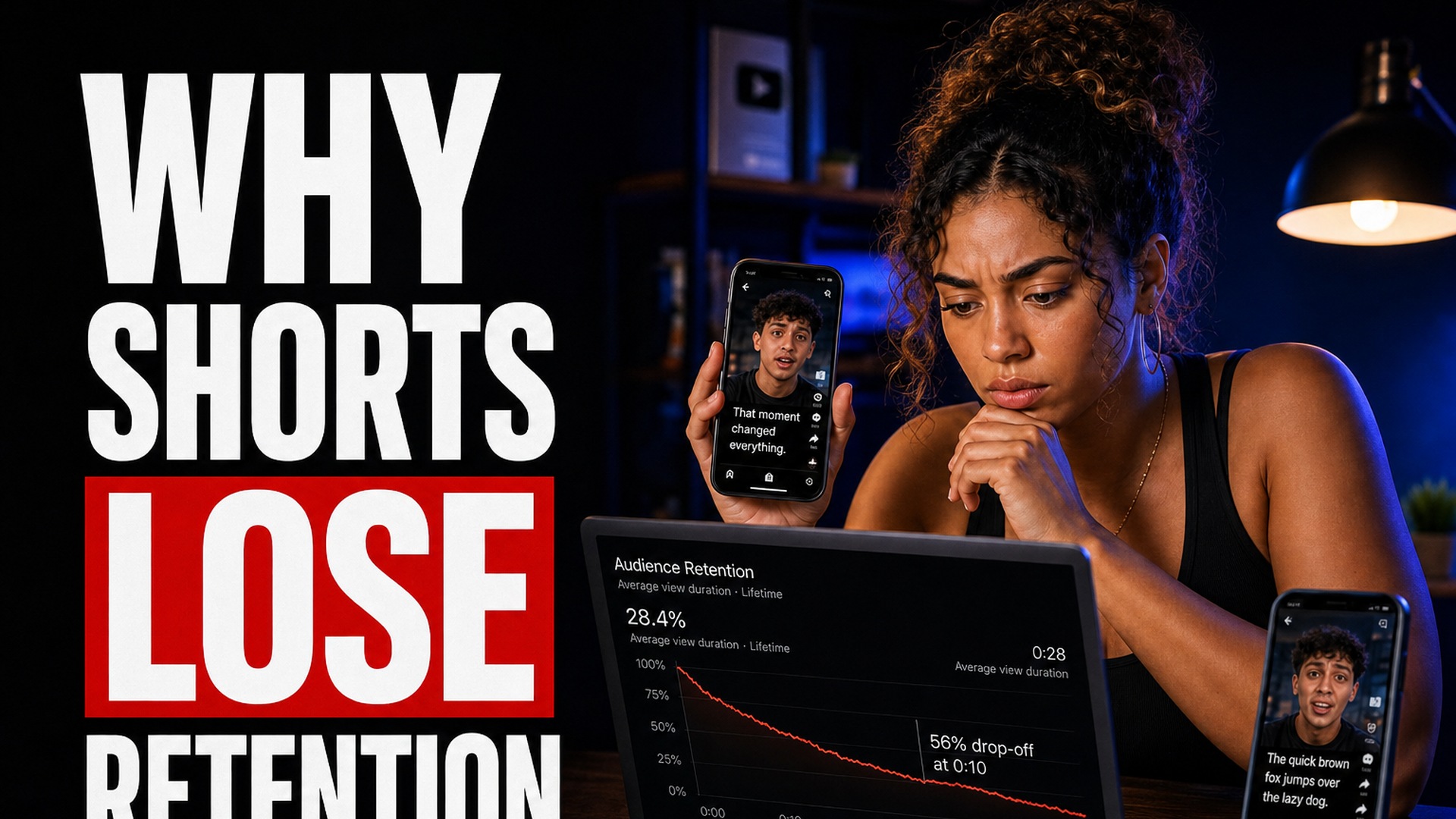
Short-form retention usually dies before your idea is “bad” — slow hooks, unreadable captions, and subtitle pacing that fights the cut. We audited dozens of TikToks, YouTube Shorts retention curves, and Reels: viewers decide in under two seconds on mute. Fix rhythm first (shorter chunks, transcript-first, final vertical export) — our Shorts workflow and timing guide go deeper.
You posted a Short you were proud of. Topic was fine. Energy was there. Comments were kind. And the retention graph looked like you pushed everyone off a cliff at second four. The default story is “the algorithm hates me.” Sometimes true. More often we saw something else: why viewers scroll away had almost nothing to do with your personality and everything to do with pacing, captions, and how the clip feels on a phone in a crowded feed.
We are not growth gurus. We are editors who re-watched failing clips frame by frame — muted, at 2x, on the subway — and kept seeing the same TikTok watch time killers. This is what showed up in 2026, over and over.
The uncomfortable part: two clips with the same script can have wildly different curves. One opens with the payoff line on screen at 0:00. The other spends two seconds on “so today I wanted to talk about…” The second is not bad content. It is bad Shorts editing workflow — and the feed treats those the same way your viewers do.
What actually causes people to scroll away
Retention is not one mistake. It is a stack of small frictions that add up before the viewer can articulate “this is boring.”
- Slow openings — logo stings, “hey guys,” context before the hook.
- Visual overload — three stickers, two zooms, and a sound effect in the first second.
- Weak hooks — the interesting sentence starts at 0:04; the feed left at 0:02.
- Delayed captions — mute viewers wait, then bail.
- Awkward pauses — dead air you kept “for vibe” reads as broken on mobile.
- Bad subtitle rhythm — paragraphs on screen, or cues that land late.
- Confusing edits — jump cuts that do not match speech beats.
On Shorts, short-form retention drops incredibly fast. You are not fighting boredom at minute eight. You are fighting “does this feel worth the next thumb-flick” at second two.
Muted test: Play your draft with sound off. If you cannot tell what the video is about in one line of captions before the face changes expression, assume the feed already scrolled.
Why subtitle timing affects watch time
Creators treat captions as accessibility checkbox. Viewers treat them as part of the rhythm. When subtitle retention fails, watch time follows — quietly.
- Delayed captions — joke lands visually before text; comedy dies.
- Subtitles flashing too fast — eye gives up, thumb moves.
- Giant sentence blocks — reading fatigue on a 6-inch screen.
- Visual reading fatigue — neon kinetic type that looked cool in the editor.
- Subtitle pacing vs speech pacing — accurate words, wrong feel.
Bad captions do not always show up in comments. They show up as a cliff at 0:03 on the analytics page. We wrote a full breakdown in why subtitle timing still looks off in 2026 — same root cause, different symptom than “bad content.”
We tested real short-form editing workflows
Same clips, different stacks — not to crown a tool, to see where friction kills improve watch time efforts before upload:
- Mobile editing — CapCut, native TikTok, phone-only weeks.
- Desktop workflows — Premiere, DaVinci, heavy timelines.
- AI subtitle generators — auto tracks, then publish without skim.
- Browser tools — full editors vs text-first passes.
- Heavy editors — VEED, Kapwing on laptop.
- Lightweight workflows — SRT out first, style second.
Pattern: speed and export reliability mattered more than feature count. Tools that trapped you in a laggy timeline before you had readable text burned time you did not have. Our free caption apps roundup is honest about which tiers survive real use.
| Workflow | Retention risk | Best for |
|---|---|---|
| Auto captions → heavy trim after | High — timing drift | Learning the hard way |
| Native mobile burn-in only | Medium — fast but locked | Daily TikTok-native posts |
| Transcript/SRT → final vertical | Lower — if you skim text | Shorts + cross-posting |
| Desktop NLE everything | Medium — slow publish cadence | Polished weekly drops |
The biggest editing mistakes we saw
These showed up on clips with good ideas and bad graphs:
- Too many cuts — chaos without rhythm.
- Meme overload — reference lands for you, not a stranger scrolling.
- Sound effects everywhere — audio ADHD in three seconds.
- Captions covering faces — trust dies when you cannot see eyes.
- Overdesigned subtitles — style over readability.
- Zoom spam — motion without purpose.
- Jump cuts without rhythm — speech and picture disagree.
TikTok editing mistakes often feel clever in the editor and cheap in the feed. One disciplined hook beat beats five “viral” effects.
A practical audit trick: export the same clip twice — version A with your normal captions, version B with half the on-screen words and the hook text in the first 0.5 seconds. Post unlisted, compare curves, keep the winner. Boring science, but it beats guessing why improve watch time efforts failed.
Why mobile viewers behave differently
Desktop brain is not phone brain. Mobile viewers in 2026:
- Vertical attention span — thumb already hovering.
- Muted autoplay — text is the first hook.
- One-handed viewing — complexity reads as effort.
- Subway/train scrolling — distraction is the default environment.
- Visual exhaustion — hundredth clip today; low tolerance for clutter.
- Under two seconds — decision window most creators still edit for minute one.
That is why YouTube Shorts retention and TikTok completion rate punish slow intros harder than long-form ever will.
Instagram Reels behaves similarly: discovery rewards completion and replays, not “well produced eventually.” If the first screen does not earn the second, the rest of your edit never gets judged.
The two-second decision window
Analytics rarely label it this clearly, but the cliff is usually here: viewer sees your face, sees (or waits for) text, feels rhythm — then commits or scrolls. Anything that delays text, hides the face, or makes the cut feel “off” spends your only currency.
The fastest workflow we found for better retention
Not a hack — a boring stack that survived contact with real publish days:
- Transcript-first — words and breaks before fonts.
- Cleaner subtitle timing — short chunks, hook lines nudged by hand.
- Shorter caption chunks — one thought per beat.
- Edit after subtitle generation — or regenerate from final vertical; pick one.
- Simplify visual pacing — one zoom, one gag, one idea per segment.
Cutup fits the text pass: paste a link, skim, export SRT, finish in CapCut or your NLE. It is not magic retention dust — it is fewer minutes inside a browser timeline when you only needed readable cues. Pair with SRT generation and the Shorts workflow guide.
Podcasters clipping long episodes — see fastest way to turn podcasts into Shorts — lose retention the same way when the clip starts with context instead of the punch.
What “good retention” actually feels like
Good graphs feel boring to edit:
- Smooth pacing — no fight between audio and picture.
- Readable captions — mute test passes without squinting.
- Natural energy — not hyper-edited desperation.
- Visual breathing room — face + text + safe zone coexist.
- Subtitles helping rhythm — emphasis lands with the mouth.
Viewers rarely comment “great caption timing.” They just do not leave.
Why AI still does not fully understand human pacing
AI transcription in 2026 is good at hearing. It is mediocre at feeling:
- AI timing limitations — chunks follow ASR, not comedy beats.
- Emotional pacing — whispers and shouts get same block size.
- Comedic pauses — setup needs silence; captions slap early.
- Speech rhythm — you trimmed “um”; the clock did not get the memo.
- Emphasis timing — the wrong word is bolded because it was loud.
- Subtitle chunking issues — eighteen words, one cue, dead feed.
Expecting one-click captions to ship publish-ready is how accurate subtitles still tank short-form retention. Humans still win on hooks — AI wins on first draft speed.
We are not anti-AI. We are anti-shipping the first draft because the words were right. The creators who improved curves without changing topics usually changed when captions appeared and how many words were on screen — not which model they used.
Our honest take after testing everything
Channels with the steadiest curves we saw did not have the most effects. They:
- Simplified workflows — fewer apps per upload.
- Reduced editing clutter — one joke, one cut, one caption style.
- Focused on readability — contrast and safe zones over novelty.
- Used subtitles intentionally — mute is a first-class viewer.
- Optimized pacing, not just visuals — rhythm before rainbow fonts.
If you take one habit from this: re-export one Short with the hook moved to frame one, captions shortened to eight words per beat, and one fewer zoom. Compare retention before you change cameras, niches, or upload times. Most of the time the graph moves more than you expect.
Short-form videos lose retention fast when the first seconds feel slow, cluttered, or hard to read on mute. Fix hook timing, caption chunks, and the vertical file you actually post — then argue about the algorithm.
FAQ
Why do viewers scroll away from Shorts?
Usually in the first 1–3 seconds: weak hook, slow intro, unreadable or mistimed captions, or visual clutter. The feed does not wait for your payoff.
Do subtitles improve retention?
Yes for muted viewers when captions are readable and timed with speech. Bad pacing, huge blocks, or text over faces can hurt as much as no captions help.
What subtitle style works best?
Bold high-contrast text, two lines max, safe-zone placement, minimal motion. Match beats to emphasis, not raw transcription chunks.
Why do TikTok videos lose watch time?
Fast-scroll behavior, weak native rhythm, re-encode quirks, and captions that fight the edit. Viewers decide almost instantly if the clip feels feed-native.
How fast should captions appear?
With the spoken beat — often slightly before punch words on hooks. Mute-test: if text arrives late after the mouth moves, retention suffers.
Do AI captions hurt retention?
Unedited AI pacing can — accurate words with robotic rhythm read as low effort. Skim chunks and nudge hook timing before publish.
What editing mistakes reduce retention?
Slow intros, zoom spam, meme overload, captions on faces, jump cuts without speech rhythm, and dead air that reads as broken on mobile.
How can I improve Shorts watch time?
Lead with the hook, caption the final vertical export, shorten chunks, simplify cuts, and audit muted playback before upload.